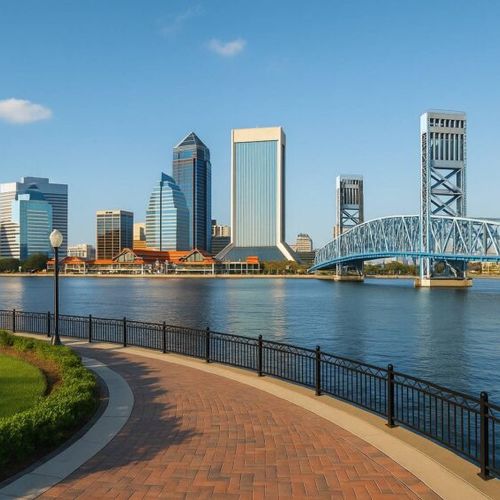

Jacksonville's housing market has settled into something unusual after a few volatile years: it's quiet. Home values are essentially flat, rents have barely moved, and mortgage rates are hovering in the high-6% range. That stability actually makes 2026 a good year to have this conversation, because the answer isn't being distorted by a frenzied seller's market or a rate environment in free fall. The numbers are what they are, and the right call comes down to your timeline and your finances more than market timing.
What renting and buying actually cost right now
The average rent across Jacksonville is about $1,523 a month, and it's barely budged — up just 0.29% over the past year. By unit type, you're looking at roughly $1,062 for a studio, $1,340 for a one-bedroom, $1,593 for a two-bedroom, and $1,910 for a three-bedroom single-family rental, which is the closest comparison to a starter home.
Buying looks different. Jacksonville's median home value is around $285,000 by Zillow's measure, though the median sale price on homes actually closing has been running closer to $300,000–$325,000. Take a representative $300,000 purchase with 10% down and today's 30-year rate of 6.95% (per Freddie Mac):
- Principal & interest on a $270,000 loan: about $1,790/month
- Property tax (Duval County's 17.86-mill rate, effective ~1.6% for a newly homesteaded buyer): about $395/month
- Homeowners insurance (Jacksonville averages $3,471/year, reflecting hurricane exposure): about $290/month
- PMI on a 10%-down conventional loan: roughly $140/month
That's a total monthly payment near $2,610 — about $1,090 more than the citywide average rent, and about $700 more than renting a comparable three-bedroom house. Worth saying plainly: at today's rates, buying costs more per month than renting in Jacksonville. The case for buying isn't a cash-flow argument right now — it's a long-term one.
Why buying still makes sense for a lot of people
Even with that monthly gap, ownership offers things renting structurally can't:
Equity instead of a receipt. Roughly $1,000 of that $1,790 P&I payment is going toward principal from day one, not a landlord's mortgage. Rent, no matter how competitive, builds nothing.
A payment that stops rising. Rent grew only 0.29% this year, but that won't always hold — landlords adjust at renewal, and there's no ceiling. A fixed-rate mortgage payment is locked for 30 years, and it eventually goes to zero. Stack a few normal years of rent growth on top of each other and the gap closes or reverses.
Florida's Save Our Homes cap. Once a home is homesteaded, the assessed value used for property taxes can rise no more than 3% a year, regardless of what the market does. That's real, durable protection against a tax bill spiraling alongside home values.
More negotiating room than in recent years. Inventory sits around 3.4 months of supply and homes are averaging 67 days on market, up from 62 a year ago. It's not a buyer's market outright, but sellers are increasingly offering closing-cost credits and rate buydowns to get deals done — leverage that didn't exist in 2021–2022.
Control and a hedge against inflation. No approval needed to renovate, no risk of a lease non-renewal or a sale forcing a move, and a fixed housing cost that becomes relatively cheaper as incomes and prices rise around it.
Who renting is still the better call for
This isn't a one-size-fits-all market, and renting is the more rational choice for several specific groups:
Anyone with a time horizon under 3–4 years. Between closing costs (roughly 2–4% of the purchase price) and the cost of selling later (typically 6–8% in commissions and fees), a short hold rarely earns back what buying costs to get in and out. If a move is likely for work, family, or lifestyle reasons, renting avoids that math entirely.
People still building savings or credit. If a down payment would wipe out an emergency fund, or a stronger credit score would unlock a meaningfully better rate, waiting and renting in the meantime is often the financially sound move rather than stretching into a purchase now.
Anyone prioritizing monthly flexibility over long-term equity. Given that buying currently runs $700–$1,100 more per month than renting, someone who'd rather keep that difference liquid — for investing, debt payoff, or just breathing room — isn't wrong to rent and redirect the savings elsewhere.
People new to the area or relocating for work. Military families, remote workers testing out a neighborhood, and early-career professionals benefit from living in a few different parts of Jacksonville before committing to one.
Anyone who doesn't want to carry maintenance costs. Florida homeownership comes with real recurring expenses — roof age, HVAC, hurricane prep and insurance deductibles — that a renter simply doesn't absorb.
People in transition. After a divorce, a job change, or a move to a new city, renting provides housing stability without locking in a long-term financial commitment before the rest of life has settled.
The bottom line
In 2026, Jacksonville doesn't hand either side an obvious win. Renting is cheaper month to month, sometimes by over $1,000. Buying costs more today but builds equity, locks in your housing cost against future increases, and comes with tax protections renting doesn't offer. The deciding factors are personal: how long you plan to stay, how much monthly flexibility you need, and whether you'd rather have a lower payment today or a growing equity stake over the next decade. Running your own numbers — including current lender incentives, since many sellers are offering rate buydowns right now — is worth doing before deciding either way.
Check out this article next